Get your next client on autopilot
Inside AI Autopilot Academy you get my 27-day Claude Code mastery program with a 1-click install setup file, so you’re up and running on day one. Plus my GoHighLevel CLI, the Skool Automation MCP and Jarvis +. And you get a proven Claude Code content system to get your next client on autopilot.
Claude Fable 5.2 dropped on November 9, and half my feed switched every session to it the same day. That’s how you burn a week of Claude usage by Wednesday.
Fable vs Opus isn’t a “which is smarter” question. Fable 5.2 is the smarter model. The real question is which one you let run all day, and which one you call in for the hard parts.
I’m Charles J Dove, I run Charlie Automates, and I’ve been building client systems on Fable for months. Here’s the price math, the effort settings, and the exact setup I run in Claude Code right now.
What Is the Difference Between Claude Fable 5.2 and Opus 5.5?
Claude Fable 5.2 is Anthropic’s most capable widely released model, built for hard reasoning and long agent runs. Claude Opus 5.5 is the current Opus, and it’s the model Anthropic points most everyday coding at. Same 1M token context window, same 128K max output, same tokenizer.
The difference is price and how hard each one thinks:
| Claude Fable 5.2 | Claude Opus 5.5 | |
|---|---|---|
| Input (per 1M tokens) | $8 | $4 |
| Output (per 1M tokens) | $40 | $20 |
| Cache reads (per 1M tokens) | $0.20 | $0.20 |
| Fast mode (per 1M in/out) | $16 / $80 | $8 / $40 |
| Context window | 1M | 1M |
| Max output | 128K | 128K |
| Effort to start at | high | medium (the default) |
So Fable 5.2 costs exactly 2x Opus 5.5 per token, and 20% less than Fable 5.1, which ran $10 / $50. If you skipped Fable 5.1 because of the price, 5.2 is the cheapest Fable has ever been.
Is Fable 5.2 Worth 2x the Price of Opus 5.5?
Fable 5.2 is worth 2x the price on work where one wrong decision costs you hours: architecture calls, a bug three sessions haven’t fixed, a multi-part build that runs for hours on its own. On everyday work it isn’t, because Opus 5.5 does that work fine for half the price.
Here’s how I split it:
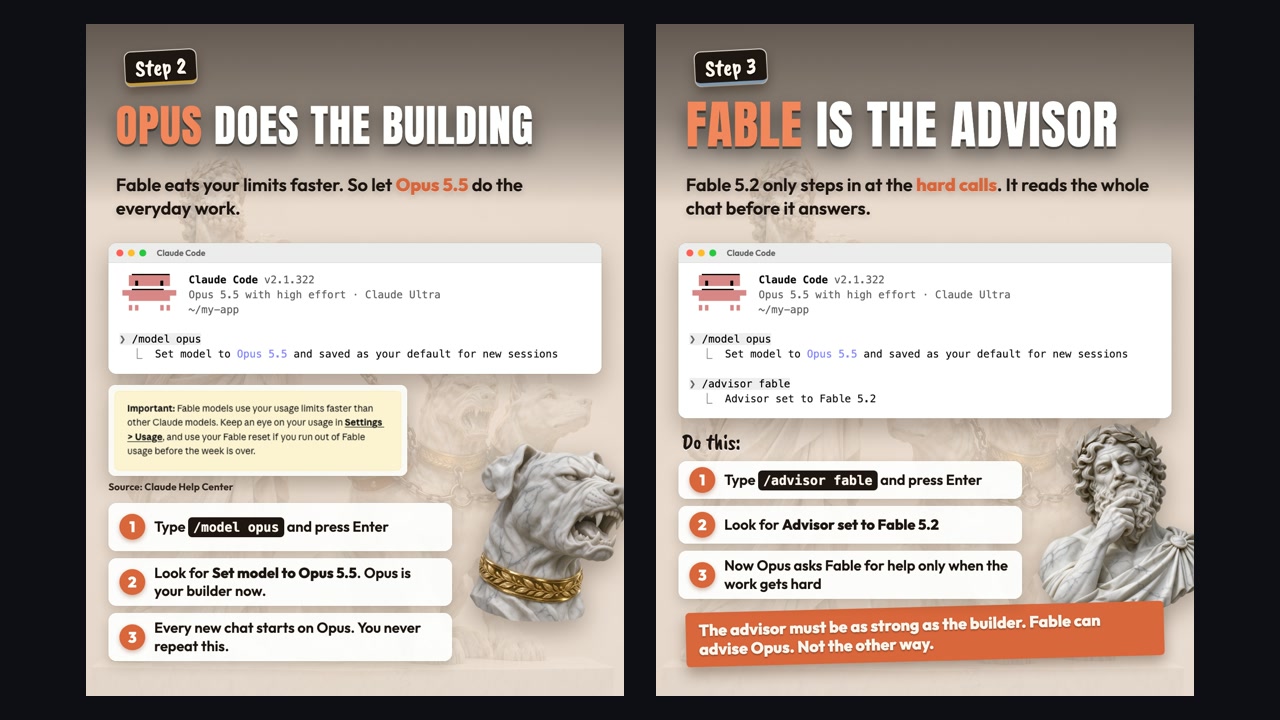
- Opus 5.5 builds. Every new chat starts on Opus. Edits, small features, content work, scripts, client tweaks.
- Fable 5.2 advises. It only steps in at the hard calls, through the Claude Code advisor (more on that below).
- Fable builds on the big jobs. When I run a large multi-part build with parallel agents, Opus does the research and Fable does the building, and each builder owns its own files so nothing collides.
The token price only tells half the story though. If you’re on a Claude plan instead of the API, you never see $8 or $40. You see your usage limit drain. The Claude Help Center says it plainly: “Fable models use your usage limits faster than other Claude models.”
That’s the real cost of running Fable all day. Not dollars. Running out of Claude on a Wednesday.
How Do You Switch Between Fable and Opus in Claude Code?
Switching between Fable and Opus in Claude Code takes one command, and it saves as your default for new sessions:
- Type
/model fableand press Enter. On some plans Claude Code asks you to OK usage credits one time. Pick continue. If it doesn’t ask, you’re already set. - Type
/model opusand press Enter. You’ll see “Set model to Opus 5.5 and saved as your default for new sessions.” - Type
/advisor fableand press Enter. You’ll see “Advisor set to Fable 5.2.”
Now Opus does the work and asks Fable for help only when the work gets hard. One rule to remember: the advisor has to be at least as strong as the builder. Fable can advise Opus. Opus can’t advise Fable.
I wrote the full walkthrough, with what the advisor actually caught in my test, in how to stop Fable from burning your Claude usage limits.
Which Effort Level Should You Use With Fable 5.2?
Start Fable 5.2 at high effort. Gains above high are uneven, so only move to xhigh on a task where you’ve actually seen it make a difference, and save max for the rare job where time and tokens don’t matter at all.
Opus 5.5 is different. Its default effort is medium, one notch below the old Opus 5. For big agent runs I bump Opus to high. For quick edits, medium is plenty.
Two things that trip people up on both models:
- Thinking is always on. You can’t turn it off on either one. Effort is your only dial.
- Effort barely changes how long the answer is on Fable 5.2. If you want shorter replies, say so in the prompt.
When Is Fable Slower Than You’d Expect?
Fable is slower on long autonomous jobs because it thinks longer per turn, and single requests on hard tasks can run for many minutes. I learned that the hard way.
When I ran Claude Code vs Codex on one website prompt, Fable 5.1 took 2 hours 45 minutes to build a med spa site at medium effort. GPT-6 Astra finished in 1 hour 18 minutes. Part of that gap was sub-agent issues on my side, but the lesson stuck: Fable is the model you give the job to, then walk away from. Not the model you sit and watch.
If you need speed, both models have a fast mode at 2x the standard price. Fable 5.2 fast mode runs $16 / $80 per million tokens.
Fable vs Opus: Which One Should You Use?
Use Opus 5.5 as your default and Fable 5.2 as your advisor. That’s the right setup for most people reading this, and it’s what I run every day.
| Your situation | Use |
|---|---|
| Everyday coding, edits, content, scripts | Opus 5.5 (medium or high effort) |
| A hard bug or an architecture decision | Opus 5.5 with Fable 5.2 as advisor |
| A long multi-part build you’ll walk away from | Fable 5.2 at high effort |
| Tight budget or high-volume grunt work | Sonnet 5.5, or a cheap skill like Jev |
| You’re on a plan and keep hitting limits | Opus builds, Fable advises, never Fable all day |
The model matters less than the system around it though. Your skills, your rules and your memory decide more of your output than which model sits in the chair. That’s the whole idea behind the 3-step system to build an agentic OS, and it’s why I care about which Claude Code skills you install, and in what order.
Key Takeaways
- Fable 5.2 costs 2x Opus 5.5: $8 / $40 per million tokens against $4 / $20. It’s 20% cheaper than Fable 5.1.
- Same 1M context and 128K output on both models.
- On a Claude plan, the cost is your usage limit, not dollars. Fable drains it faster.
- Opus builds, Fable advises.
/model opus, then/advisor fable. - Start Fable at high effort. Opus 5.5 defaults to medium.
- Give Fable the long jobs you walk away from, not quick edits you watch.
Where to Go From Here
Get your next client on autopilot.
Join AI Autopilot Academy for my 27-day Claude Code mastery program with a 1-click install setup file, plus a proven Claude Code content system to get your next client on autopilot.
Members also get my full Fable 5.2 token setup inside the Academy, the same Opus-builds, Fable-advises flow I use on client work at my agency CC Strategic. New tests like this drop every week on the Charlie Automates YouTube channel @charlieautomates, and the free tools live on charlieautomates.com.
FAQ
Is Claude Fable 5.2 better than Opus 5.5? Yes. Fable 5.2 is Anthropic’s most capable widely released model, and it’s built for harder reasoning and longer agent runs. But it costs 2x Opus 5.5 per token and drains plan usage limits faster, so Opus 5.5 is the better default for everyday work.
How much does Claude Fable 5.2 cost? Claude Fable 5.2 costs $8 per million input tokens and $40 per million output tokens on the API, with cache reads at $0.20. That’s 20% less than Fable 5.1 at $10 / $50. Fast mode costs $16 / $80.
Can I use Fable 5.2 in Claude Code?
Yes. Type /model fable in Claude Code. On some plans you confirm usage credits once. You can also keep Opus as your main model and set Fable as the advisor with /advisor fable.
What is the difference between Fable 5.2 and Mythos 5.2? Fable 5.2 and Mythos 5.2 share the same capabilities and pricing. Mythos 5.2 is only available to verified organizations, while Fable 5.2 is available on paid Claude plans, the Claude Platform and the major cloud platforms.